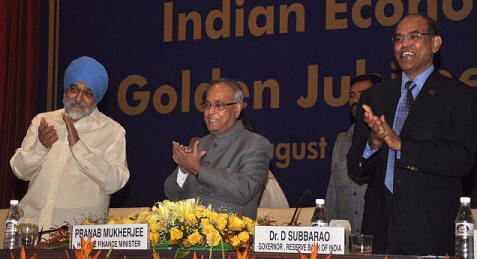
Business Line The Finance Minister, Mr Pranab Mukherjee, flanked by the RBI Governor, Dr D. Subbarao, and the Deputy Chairman, Planning Commission, Mr Montek Singh Ahluwalia, at the Golden Jubilee Celebrations of the Indian Economic Service in the Capital on Monday. – Ramesh Sharma
NEW DELHI, JULY 29:
The Reserve Bank of India (RBI) Governor, Dr D Subbarao has outlined five principles that economists in the Government must keep in mind while shaping economic policy.
Addressing the inaugural function of the golden jubilee celebrations of the Indian Economic Service (IES) here, Dr Subbarao highlighted that the global financial crisis of 2008 was in many ways a wake-up call for economists to introspect on their profession, on their scholarship and on their professional conduct.
The first principle, he said, that economists need to remember is to practice economics as a people matter, which is other way of saying that economics is not physics.
“Economists should remember that they deal with world of people. Economics is not like physics because it deals with real world of people, its laws are not immutable and knowledge progression in economics is one way street”, Dr Subbarao said.
The second principle is that when economists build models, they should fit it to the real world and not the real world to the models.
“The models that have been built by economists are dictated by convenience and not conviction. Economists model what they can and not what they should”.
Dr Subbarao said that macroeconomics is not aggregation of microeconomics as models assume.
The other principles that economists would do well to remember is that economic policy making is more than straight application of text book knowledge, need to apply judgement, avoid group think and have a sense of history.
“The stereotype reply from economists is that they didn’t see the crisis coming because the world had changed.
It’s very important to have a sense of history in order not to repeat mistakes, at least learn from them. You can never prevent another crisis but at least you can mitigate the chances of a crisis blowing up or indeed if a crisis were to occur you will be well equipped to handle it”, Dr Subbarao said.
[email protected]