Current
Account Deficit
The
Problem, Analysis & Solution
June,
2013.
Rashmin Chandulal Sanghvi
Chartered Accountant,
Mumbai.
Contents
Page
|
S.N.
|
Particulars
|
Page
No.
|
|
|
Preface
|
1
2
|
|
|
Main Paper
|
3
20
|
|
1.
|
The Problem CAD
|
3
|
|
2.
|
Seriousness of the
Problem
|
3
|
|
3.
|
Solution adopted so far
|
3
4
|
|
4.
|
Rupee Depreciation/
Devaluation
|
4
|
|
5.
|
Functions of Money
|
4
6
|
|
6.
|
Inflation in India
|
6
9
|
|
7.
|
Gold Carry Trade
|
9
11
|
|
8.
|
Gold Price Crash&
Other Games
|
11
13
|
|
9.
|
Cause Effect Cause
|
13
14
|
|
10.
|
Current Account Deficit
|
15
16
|
|
11.
|
External Causes. Adverse Terms of Trade
|
17
18
|
|
12.
|
Who will defend Rupee?
|
18
19
|
|
13.
|
Action Plan in Brief
|
19
- 20
|
|
Anex.
1
|
CAD & Philosophy
|
|
|
Anex.2
|
Defending Falling
currency
|
|
|
Anex.3
|
Economics is a People
Matter
|
|
|
Anex.4
|
India
US
comparison
|
|
Short Forms
|
BOP - |
Balance
of Payment
|
|
CAD - |
Current A/c. Deficit |
|
CAS - |
Current A/c. Surplus |
|
FI - |
Financial Institution
|
|
FX - |
Foreign Exchange
|
|
GOI - |
Government of India |
|
GR - |
Government of India & RBI |
|
MOF - |
Ministry of Finance
|
|
RBI - |
Reserve Bank of India |
|
SEBI - |
Securities & Exchange
Board of India |
Preface:
-
Current Account Deficit
(CAD) is a huge national problem.
No single authority or person can solve the problem. Collective action will be required.
-
This paper is to discuss
& analyse the national challenge and to search for its solutions. There is no intention to criticise any person or
authority.
-
I am convinced that in economics, RBI and
Ministry of Finance (MOF) know better than me, and better than most columnists
and experts in and outside India. So when I have a difference of opinion with RBI/
MOF on financial matters, they would be right. |And
yet, when there is a difference of opinion, it may be raised and discussed. We
are a mature democracy. I do have a serious difference of opinion. I present both views and try to justify my
views. I request you to debate with me.
I will learn.
-
Dr.
Subbarao, Governor, RBI said on 28th July,
2012 that Economics is a People Matter . Do not treat it like physics. I fully agree. Economics is the study of
Human behaviour in the economic field: the causes
of the human actions and the results
of those actions. |Individuals do behave in an unpredictable
manner. But summation of individual behaviours the society s behaviour can be
studied and analysed. Future can be
projected. This is economics.
Since Economics is dealing with human beings
Study of psychology & philosophy is intrinsic part of
Economics. We will see how philosophy
plays out its role in real life.
-
Dr. Subbarao said at IMF meeting
in April, 2013 that Defending a falling
currency is like trying to catch a falling knife . Let us discuss whether Rupee fall should be
and can be prevented or not. And how not catching the falling Rupee is
causing serious damage to the Indian economy.
-
A clarification: I firmly believe in the
concept of Advait
we are all one . We are not just
similar. We are all manifestations of
same God. Hence when I criticise a view
or policy especially the policies adopted by the U.S. Government and the
cartel of banks; I only criticise the
policies. Not the human beings
acting out the particular role.
While philosophically we are all one; in this
material life, some people do act detrimentally for others. Our role in the drama demands that we analyse
the policies and actions; defend ourselves from the detrimental actions and
expose the policies so that others may protect themselves.
-
Un Ekant Vad:It is said that for every issue, there can be
several views. TundeTundeMatirbhinnaha. And every
person is right from his view point. Maturity of debate is where we try to
understand all view points.Having heard all practical
views, if we can take a holistic view, we can find a solution.
Views presented here are complex &
different from the views generally prevalent in the MOF & RBI. Since they
are complex, they require deep consideration. Since they are different, one
needs to understand Un Ekant Vad
as a natural human psychology.
-
Complex
& Simple:Some issues are complex. We start with simple
statement of an issue. Where necessary, we expand the same & then discuss
the complexity. At times, a simple statement of the issue serves the purpose.
Hence we do not go into full details.
-
Financial Crisis:In September 2008 US got into a financial
crisis. Soon Europe also got pulled into the
crisis. Financial crisis got enlarged into full economic crisis. Both US &
Europe had their own internal reasons. Uncontrolled greed was the root cause.
Rest of the world has no internal reason for the crisis. They had consequential
damages. While US loves to call it a global crisis, I call it a North Western Crisis . This is just an illustration of coming out
of US led thinking & thinking independently.
-
In this paper statistics have been kept to the
minimum. Most figures are rounded off. Main emphasis is on concepts &
policies.
-
FX
Reserve:A currency note
is nothing but an IOU. When an IOU of another Government is held by RBI, it is
called Fx Reserve. RBI holds approximately
U.S. $ 300 Billion worth of foreign exchange reserves. Most of the reserve must be in U.S.
$, Euro, Yen & Pound. It means India has given
a loan of $ 300 Bn. to these countries. They do not hold Indian Rupee as
reserve. Hence they do not give us any
loan.
-
It is said inthat in real
life, things happen as a process, as an ongoing
cycle. Nothing is simple cause & effect. There are several cycles simultaneously
acting & counteracting. Please see annexure on CAD & Philosophy .
Preface Completed
Next: Main Paper
-
The
Problem: CAD
For the last 66 years India has
suffered Current Account Deficit in every year - barring one exception. The liberalisation that started in 1991 has
by now benefited many sectors; and substantial growth has been achieved. Still,
CAD has only worsened. There must be a reason. Something somewhere is seriously
wrong. This wrong has to be addressed. We may discuss different hypotheses on
what is wrong.
-
Seriousness of the Problem:
Every year the import of goods and services
by India
is more than the export of goods and services.
This results in a CAD. Hence we
find it difficult to finance the imports.
This deficit is more than compensated by:
-
NRI investments and remittances.
-
Indian Residents black money which was lying
abroad coming back to the country.
-
Foreign
Direct Investment (FDI).
-
Portfolio
Investments by Foreigners.
-
Loans
& ECBs taken from abroad.
In short, mainly Capital Account Surplus finances the CAD. A part of the capital account inflow (iii to
v) has to go back. This, in a way is
liability. We can t rely too much on the
same. Ultimately, the country
has to achieve a Current Account Surplus (CAS) or a Current Account Balance
(CAB). I have attempted quantification of one time & continuing losses on
account of CAD in paragraphs 6.2 to 6.4.
-
Solution
adopted so far:
3.1 What can be done to control
CAD? Following strategy has been
implemented repeatedly in the past.Devalue the
Rupee. It was supposed to have
following benefits:
-
It makes imports
costlier. Hence imports will
reduce. To the extent that the imports
are inelastic, import cost will increase.
Hence customs duty revenue
will increase.
-
Our exports become more competitive. So India can export more.
-
Increased
exports and reduced imports will reduce
CAD.
3.2 Before the year 2000 it was a clear policy
of RBI: If by market forces Rupee falls, let it fall. But if Rupee is
rising, buy foreign currencies, sell Rupee & arrest the rise. A large part
of Fx Reserve has been built because of market
operations.
3.3 USGovernment knows that all supplier countries try to
keep their currencies low as compared to $ - just to be able to export more.
Situations arise when people are not ready to invest in US treasury bonds. Then
US Government lowers the $ value. Central banks of the world rush to buy $
& depreciate their currencies to maintain the rate with $. This amounts to forced lending to US Government by the
Central Banks.
-
Rupee
Depreciation/ Devaluation.
4.1 Consider
the extent of Rupee depreciation
during last 66 years.
|
In the year |
Re. value against U.S. $ |
|
1947 |
4 |
|
1981 |
8 |
|
1991 |
18 |
|
2013 |
56 |
Hence Rupee has depreciated against $ by
1400%. Or in other words, today Rupee
value is 7% of its value in 1947.
Now see how much $ has depreciated.
|
1947 |
$ 35 per ounce of gold.
|
|
2013 |
$ 1400 per ounce of gold. |
U.S. $ has depreciated to 2.5% of its value
in 1947. Against a depreciating $; Rupee has depreciated. Hence against gold,
Rupee has depreciated to 7% of 2.5% = 0.18% Or one upon 560th of the
original value.
This massive devaluation/ depreciation of
Rupee has resulted into proportionate inflation. See paragraph 6.
4.2 World
Bank, OECD & UN use the Purchasing
Power Parity of a currency to compare GDP of different countries. On PPP,
Indian Rupee value should be Rs. 20 per US $. In
comparison, market rate - Rs. 56 per $ is one
third of the PPP rate. Market value of Rupee is one third the PPP value.
-
Functions
of Money:
Extract from Wikipedia on Functions of
Money:
5.1 Medium
of exchange
When money is used to
intermediate the exchange of goods and services, it is performing a function as
a medium of exchange. It thereby avoids the inefficiencies of a
barter system.
5.2 Unit of account/ Measure of Value.
A unit of
account is a standard numerical unit of measurement of the market
value of goods, services, and other transactions. Also known as a
"measure" or "standard" of relative worth and deferred
payment, a unit of account is a necessary prerequisite for the formulation of
commercial agreements that involve debt. To function as a 'unit of account',
whatever is being used as money must be:
-
Divisible into smaller units without loss of value;
precious metals can be coined from bars, or melted down into bars again.
-
Fungible: that is, one
unit or piece must be perceived as equivalent to any other, which is why diamonds, works of art or real estate are not suitable as money.
-
A specific weight, or measure, or size to be
verifiably countable. For instance, coins are often milled with a reeded edge, so that any removal of material from the coin
(lowering its commodity value) will be easy to detect.
5.3. Store of value
To act as
a store of value, a money must be able to be reliably saved,
stored, and retrieved and be predictably usable as a medium of exchange when
it is retrieved. The value of the money must also remain stable over time. Some
have argued that inflation,
by reducing the value of money, diminishes the ability of the money to function
as a store of value.
5.4. Standard of deferred
payment
While standard
of deferred payment is distinguished by some texts particularly
older ones, other texts subsume this under other functions. A
"standard of deferred payment" is an accepted way to settle a
debt
a unit in which debts are denominated, and the status of money as
legal
tender, in those jurisdictions which have this concept, states that
it may function for the discharge of debts. When debts are denominated in
money, the real value of debts may change due to
inflation and
deflation,
and for sovereign and international debtvia
debasement and
devaluation.
Extract from Wikipedia completed.
5.5 Paper currencies have no intrinsic value. They are simple IOUs
issued by the Government. Any IOU is respected only if the person issuing the
IOU is committed to fully repay the value of the IOU. Inflation & falling value
of Rupee show that the Government & RBI are not committed to the repayment of
full value. This is true for most Governments today. Hence Governments have to
pass laws to ensure monopoly of the currency issued by them and to force people
in accepting their currencies. Hence it is known as Fiat Currency.
Some Governments
ensure that the currency notes issued by them perform the functions of money
exchange, measure and store of value.
These currencies are accepted globally.Some
Governments do not take the responsibility of performance. They simply rely on the force of law. Indian
Government & RBI actually act contrary to their functions of maintaining exchange
and store functions of money- Rupee. (i)
Under FEMA, they rule that Rupee cannot be traded outside India. Exchange
function of money is restricted. (ii) They ensured that Rupee keeps
depreciating almost continuously. See paragraph 4 on Rupee depreciation. (iii)
Today they may not deliberately depreciate Rupee. But they do not accept the
responsibility of maintaining the value of Rupee. See RBI Governor s statement
that: trying to arrest the fall of value of a currency is like trying to catch
a falling knife. (Annexure 2)
Can Rupee succeed
as a Currency?
-
Inflation in India.
6.1 In
August 2011, S & P down
graded US Government debt&
there was sudden chaos in international markets. Instead of crashing, the US $
rose in international markets. Because,
instead of running away from $, banks & FIs transferred their global funds
to US $. So much for the international bankers claim for being geniuses. Rupee
started falling. RBI did not protect the value of rupee. It fell from Rs. 45 per $ to Rs. 50 per $.
More than 10% fall in less than one month.
By June, 2013 it has gone down to Rs. 56 per
$. A depreciation of Rs. 11 in two years.
6.2 Report
in Economic Times on 7th November, 2011 says that due to sinking
rupee, some companies have suffered losses of Rs. 1130 crores
(or Rs.
1.1 billions). Several companies which were otherwise sound, have gone
insolvent. There is much larger loss to India.
6.3 Necessary
consequence was that oil importing companies have to pay more. If we import $
100 billion worth of oil, the oil companies have to pay Rs. 1,100 billion (Rs. 11,00,000 crores more). Either they increase the price or they suffer
losses. If they increase prices, there is inflation. If they don t increase
prices, they will suffer losses which have to be financed by Government
whose deficit will increase resulting in inflation. This is chain effect of Rupee depreciation, or a
vicious cycle.
6.4 We are import intensive country. We
import
goods & services worth $ 500 billion every year. In two years, the cost of
imports has gone upby Rs. 5,500 billion(500 *11). Our External Debt is $ 300
billion. In Rupee terms it has increased
by Rs. 3,300
billion. India has become poorer by Rs. 3,300 billion; and keeps getting impoverished by Rs. 5,500 billion every year on account of
imports. Then the Government & RBI
say: they don t know why inflation cannot be controlled! Increase in the cost of inelastic
imports has increased CAD. It
may be noted that generally in exports we do not get
more money when Rupee depreciates. Generally the foreign buyer succeeds in
reducing $ value of our exports. Hence with depreciating rupee our export
proceeds in Rupee terms remain same, and in $ terms fall.
Note: in
Economics precise calculations are not possible as there are too many forces
acting & counteracting. Above calculations only indicate that because of
depreciating rupee India suffers huge losses.Cause
of CAD is falling Rupee.
6.5 If there is inflation, people
protest & there is political instability. With inflation, whole country
suffers increase in costs. Exports become less competitive. With every fall in rupee
investors suffer.
6.6 GOI &RBI
(GR) have the duopoly of foreign exchange. Is it not their duty to protect the value of rupee in exchange markets?In normal times RBI took a defensive role. Now when
the whole world economies are in chaos, when US government together with a cartel of financial
institutions is manipulating value of $; and maintaining $ hegemony over world
economy, can we afford a defensive role by
RBI?
6.7 PM., FM. &RBI say Rupee
will find its own level in the open market. One may note that there is no free market All markets are manipulated by several Governments
& Financial institutions in partnership. In these markets if we remain silent
spectators; we suffer. Unbearable inflation will cause riots & Government
can fall. And yet, the Government is paralysed. No effective decisions are
being taken to protect Indian economy.
6.8 Consider:Undervaluation of Rupee means
For the same
quantity exported, we get less value.
For the same
quantity imported, we pay more.
In effect
Indian resources get transferred to the countries with which we trade.
In economic
terms it is called Adverse Terms of Trade .
It is Indian
exploitation that we do not even admit. Leave alone fight.
6.9 Observations:
CAD results into Rupee
depreciation, which results
into inflation. People with incomes increasing at a
rate lower than the rate of inflation are poorer to that extent. Rich people
find their wealth being eroded at a fast rate. In case of fixed income earners,
the wealth erosion is faster than rate of earning. Hence the principal value of
their wealth keeps falling. No wealthy people will accept this lying low. For
last 66 years people have transferred their wealth abroad in other currencies
which do not depreciate as much as Rupee depreciates. Normal route of investing
in another currency would be to remit funds abroad through banking channel.
Since FERA prohibited such transfers, wealthy people remitted funds abroad
through hawala channel.
People have transferred their wealth in or out of the country at their sweet will.
Objective
of FERA of Conservation of Foreign Exchange has failed. And the policy has caused damage to
the Indian economy. FERA will go down the history as a law that has failed.
(There are important areas where Controls have tremendously helped Indian
economy. These are stated in paragraph 6.11 below.)
When
people transfer funds abroad through the hawala channel, it has to
reflect in some manner in some trade/ other transaction. (i)
Undervaluation of exports, (ii) overvaluation of imports of goods &
services (where customs duty is nil or low) (iii) smuggling of gold, (iv) NRI
inward remittances through hawala channel, (v)
accepting commissions on purchases abroad; etc. are some of the methods used
for transfer of funds abroad. These transactions
increase CAD. Some NRI remittances affect the BOP directly.
GR s
efforts in controlling CAD & supporting BOP (by devaluing Rupee &
prohibiting remittances abroad) result in increase of CAD. GR policies appear to be counter productive. These
policies have not changed with liberalisation. This may be the reason why we
have got CAD for last 66 years and liberalisation has not reduced CAD.
6.10 Benefits
of Controls:
It is said that one can understand Advait only if one can take the good & the bad simultaneously. Just as GR policy under FERA has caused
damage, it has also saved this nation from bankruptcy in following cases:
-
South East Asian (SEA) Crisis in the year 1997. Thailand,
Indonesia, South Korea & Malaysia went insolvent in this crisis. The FX
speculators & gamblers made huge money in this crisis. Emboldened by their
success in the SEA countries, they made massive speculative attacks on the
currencies of Mexico, Argentina, Russia & so on. All these countries saw
massive depreciation of their currencies. World experts had to accept that it
was due to exchange controls that these speculators could not attack Indian
Rupee & Chinese Yuan. We were saved from the capital flights & attacks
of FX gamblers.
-
North West Crisis of 2008 to 2013 & onwards.This crisis is not over yet. It may become even more serious before
normalising. Root cause of this crisis is uncontrolled greed
by their bankers, institutions & even Governments. India is less affected
than the North West countries because our RBI, SEBI & MOF have proved to be
much better than their counter parts in the US & Europe.
These
two crises have silenced critics of FERA policies of the GR. They criticised
from one view point - Ekantvad.
When circumstances completely changed, they were silenced. However, a Holistic
view may suggest: Control the
bankers & financial institutions that have succeeded in changing the North
Western laws to legalise their greed. Control speculation through derivatives
& other means. But liberalise regular trade & investment. Maintain the
value of Rupee & in fact allow increase in value of Rupee. Somehow Finance
Ministry continues to give massive reliefs to these speculative foreign
institutions & controls genuine trade.
6.11 Before proceeding
further, let us discuss some concepts and
trends. For each issue discussed below there can be many views. We may openly
discuss important issues and skip obvious issues considering the availability
of time.
-
Gold Carry Trade
Note: This is an extract of main
article on Currency Wars. See the website for full article: www.rashminsanghvi.com .
https://www.rashminsanghvi.com/articles/economics-&-investment/Indian_economics/currency_wars.html
U.S. Government and a
small, select cartel of FIIs are alleged to have carried out the Gold Carry
Trade. This game is explained in some
hypothetical steps. US Government claims that it has 8,000 tonnes
of gold in its reserves.
7.1 U.S.
Government would lease
gold to Union Bank of Switzerland (UBS), Goldman Sachs, Lehman Brothers,
Citibank, etc. Let us say, 100 tonnes of gold is
leased.
Gold may or may not move
out physically. In these days of digitalisation, who
wants the real thing! Virtual is better than the real. The custodian
will issue receipts to the FIIs that it is holding gold on behalf of the
FIIs. Receipts will be in smaller quantities. Some people do insist on physical
delivery. Women would rather wear jewellery than hold
digital receipt of gold. One Asset in hand is better than two digital assets.
Where required, gold will be delivered.
As far as US
Government is concerned, it will continue to claim that it is still the
owner of gold. It has not sold anything. In reality it owns paper promise for
gold. There is a difference between a paper promise & the real thing.
Since few people ask for
delivery, it is possible for the US Government to lease out more than 8,000 tonnes of gold. It may have leased out even 12,000 tonnes of gold. This is similar to banks
lending more than their deposits. By a Multiplier System US Government
creates gold out of thin air, leases the same & controls gold price.
7.2 FIs
will pay a small lease rent to
the US Government.
7.3 FIs
will sell gold in the spot market. They will get cash which
will be used in the derivatives business to earn income. Net of lease rent, FIs
will expect to earn profits.
7.4 FIs
will buy gold in futures . As far as FIs are concerned, they
have sold gold and bought gold. Hence technically, the gold taken on lease is
still with them. It is possible that for all the transactions lease sale on
spot buy in futures only custodian s receipts have changed hands.
7.5 It
is also possible that some gold is actually delivered in the market. In fact it
is planned to continue deliveries in the market so that gold prices
continuously go on reducing or at least remain stable. In ten years from 1990
to 2000 several Central Banks around the world have sold hundreds of tonnes of gold. And gold prices remained range bound for
almost twenty five years (from 1980 to 2005) after the Nixon Shock was over. (Barring a few
disturbances for specific reasons.)
This way, they make
substantial profits on sale and buy operations. The cartel was happy &
confident in Gold Carry Trade. Bankers who made profits out of thin air, were
taking huge bonuses and congratulating themselves for being so intelligent .
U.S. Government was happy that $ to gold price was stable. This process could
continue with some disturbances till the year 2006.
7.6 Banks
could legally say that they have fulfilled all banking reserve ratios and the
balance sheet is great. They are earning profits and everything is rosy.
By 2006 the trend became
intense. More and more people were buying gold instead of hoarding $. By 2008
gold buying rush became gold buying avalanche. Today, prices have risen from $
400 per ounce to $ 1400 per ounce.
Extract from
the Article completed.
7.8 All
the banks which had conducted Gold Carry Trade had to stop selling gold and
start buying gold. But if all the banks need to buy say, 2000 tonnes of gold, it is simply not available in the market.
(This explains steep rise in gold prices between 2006 & 2010.) All these
banks could have incurred huge losses.
American Government does
not make losses as long as banks are able to keep their promise. However, many
banks have gone insolvent. U.S. Government has bailed out the banks. Consider
how much leased gold is recovered and how much not recovered. This will
remain a top secret until someone leaks out the facts.
Conclusion: The Gold Carry
Trade cartel has failed. So have the banks. Bail Out doles kept some banks
running & some went insolvent. And no one has blamed the Gold Carry Trade.
US Government keeps bailing out others. Who will bail out US Government!
The coordinated attack
on gold price on 12th April, 2013 is a separate story. However, it
was observed even by non-economists that: While the cartel had sold paper gold,
retail consumer had bought physical gold in a big way. The impact of sudden sale of 500 tonnes of paper gold had soon reduced considerably. And stock of physical gold with Indian as
well as US shops were emptied.
-
Gold Price Crash
8.1 US had linked $ to gold. It was U.S. Government s promise to pay one
ounce of gold for every $ 35 returned to Federal Reserve. After 2nd world war, rest of the
world did not have sufficient gold for such linkage. Europe & Japan were destroyed. Rest of the world was colonised &exploited
for 200 years. No one had any
wealth. Hence $ became global trade and
reserve currency. British Pound declined
from the status of global currency.
8.2 In the year 1972, President,
Nixon refused to honour his Government s promise. Nixon shock shattered the world. However, after
some storms, Global economy again started using US $ as the global currency for
trade & reserves. USA could break its promise and yet maintain its super
power status through several means.
However, USA realised the importance of gold price expressed in $. Having burnt fingers, USA tried to regain
control over gold prices.
8.3 Look at it from another
angle. When we want to consider & compare Rupee value, we compare with US
$. When we want to compare $ value, we compare it with what? Generally gold. If
gold price goes up, it means, $ price goes down & vice versa. If some one wants to maintain $ price & confidence in $,
he should try to destabilise gold price & confidence in gold.
8.4 From 1980 to 2000 Gold Carry Trade
was carried on and gold price
remained below $ 400.
8.5
-
World Trade Centre, Enron &
Arthur Andersen collapse showed that USA is neither invincible nor noble. Then
from 2001 to 2004 several MNCs in U.S. & Europe were exposed as having
indulged in frauds.World lost confidence in the claim
that US $ is a Safe Haven currency.
-
Iraq & Afghan wars exposed USA. Sanctions on
Iran exposed USA. It was clear to the world that U.S. Government has
attacked these countries only because they were ready to sell their oil in
currencies other than $. This was a challenge to $ monopoly over global
currencies. Many Arabs started selling $ and buying Gold.
-
China got worried about US capability to maintain
the value of $. They started using other currencies for global trade and started
selling $ and buying assets including Gold.
In
April 2006 gold price went out of US cartel s control and crossed $ 600 per
ounce. In September 2008 US Financial crisis started & soon spread to the
Europe. There were many reasons. One of them was that all their calculations on
Gold Carry Trade went haywire.
8.6 U.S. was once powerful and deserved
high economic ranking. Like all 3rd
generation rich families,
US has started declining. 1972 Nixon
Shock may be considered as an important milestone in the decline of USA as an
economic power. The decade starting from the year 2000 is another Milestone in
US downward journey.
8.7 In 1997 Indonesia was
punished. South East Asian (SEA) countries were punished for their
offence of moving to Yen as international trade currency.
[Paragraph 6.11 (i)]
https://www.rashminsanghvi.com/articles/economics-&-investment/archives/south_east_asian_crisis.html
8.7 World had regarded US as the
Invincible Super Power.But U.S. think tank knew that
U.S. was having a perennial CAD, budgetary deficit and had no Fx reserves. U.S. has less than $ 150 Bn. reserves against
its international trade of $ 2.5 trillions. It claims to have (i)
own gold of 8000 tonnes and (ii) undisclosed quantity of gold owned by others
and kept in USA for safe custody. There
are reasons to believe that all this gold has been used up for Gold Carry
Trade. Today U.S. Government owns almost no gold.
It would not continue its high standard of living without exploiting
rest of the world.So it devised systems and
strategies to continuously milk rest of the world and transfer resources to
USA.
$
Hegemony as the currency for international trade and reserve currency is the
biggest strategy. Creation of Euro as a currency was a big dent
in that strategy. US tried in the years
1999 & 2000 to destroy Euro but did not succeed.
8.8 Following are some of the methods used by USA for retaining its position as Super Power No. 1
-
$ hegemony,
forcing undervalued currency for supplier nations & over valuing own
currency, Gold Carry Trade, Exploitation of Oil through several mechanisms
including wars.Forcing open foreign markets for U.S.
goods through Super 301 and several other schemes is known but forgotten.
-
Orchestrating media campaigns, keeping
pet economists to further U.S. propaganda, using an international spy network
to destabilise countries that do not fall in line.
-
Supporting dictators, destroying democracies and
exploiting countries through puppet dictators Shah of Iran, Noriega of Panama,
Marcos in Philippines.
-
Cause Effect Cause.
9.1 In economics, the effect
becomes cause & cause becomes effect. And together they can start a vicious
cycle or a virtuous cycle. Economics is not like physics. Illustration: I drop a pen from my hand. It
has to fall. Because of gravity. No one has any doubts.In
economics there are several forces playing out simultaneously.
9.2. Gold Indians are importing gold.Because the Government
& RBI are not able to control inflation.Inflation
is another word for fall in the value of currency.
9.3 Depreciation in Rupee value is expressed in two ways:
Internally - Inflation.
Externally - Fall in exchange value.
These are two sides of the same coin.
When Rupee falls externally, inflation is bound to follow.When
there is inflation within the country, exchange value is bound to fall.
This
is the clear illustration of the concept:
Cause
- Effect - Cause Relationships.
Creating
a vicious cycle that eventually goes out of the hands of both Government & Central Bank.
Government
& RBI are blaming import of Gold for the Current Account Deficit.Both of them may realise that Both of them are
responsible for pushing people into importing gold.
9.4 Gold import
&CAD.
A
percentage of gold is imported as investment.
What is the intrinsic value of gold?
Just as Indian Rupee note has no intrinsic value, gold also has no
intrinsic value. Gold s only value is:
universally people accept it as money.
Point is:
Neither the Government, nor the RBI, will be able to change the Indian
preference for gold. So huge quantities
will be imported. So Fx
will flow out. CAD will deteriorate.
Counter Point: Historically, Indian Kings have splurged tax revenue on their
luxuries and wars. Then they have gone
broke. No one ever trusted any King for
good management of economy. No one ever held a King s IOU. What they held was gold, silver or other
commodities that they considered valuable; independent of the King. All coins
were made of some metal or other & carried intrinsic value. So they were
acceptable irrespective of who ruled the kingdom.
Incorrect
behaviour by present Government ministers and by kings for last 5,000 years
have made gold an accepted currency. It
has got into the psyche of the Indian people.
The
fact that RBI has given up its duty of retaining the value of Rupee may be one reason
for Indians not to trust Rupee & buy gold.
Conclusion If
RBI wants to control CAD it may adopt a policy of protecting the value of
rupee.
-
Current Account Deficit.
India
has suffered Current Account Deficit for too long. It has cost us dearly. With all the strategies and even liberalisation of Indian economy, we have not been
able to convert the CAD into a Current A/c. Surplus (CAs) or even near balance
on Current Account.
Notes:
(i) There are many reasons for this situation. We will analyse just the most important
reasons. (ii) Economy is final result of
several actions/ inactions by all Government of India (GOI), RBI and business
community (Indian & foreign).
However, here we consider the role of main players only.
There are two main reasons:
A. Internal.
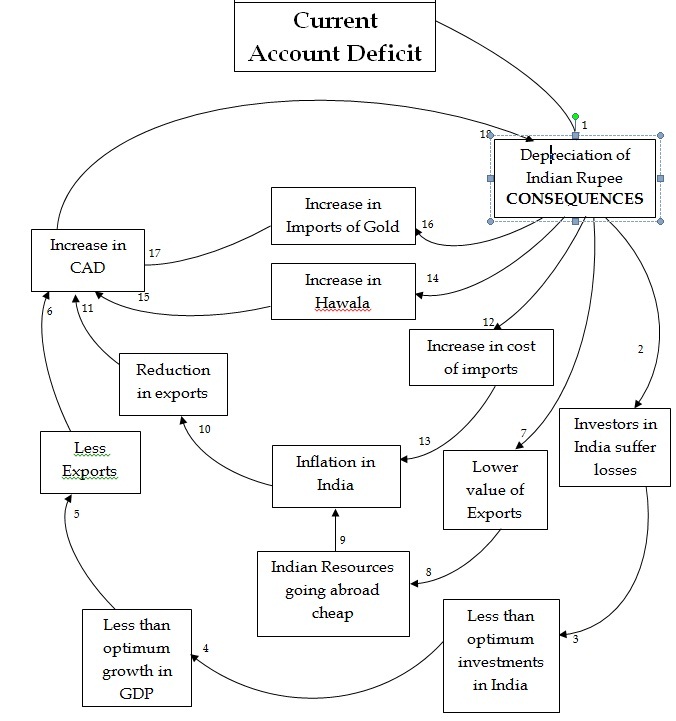
Please see the chart on the next page & Paragraph No. 12.
B. External.
Please see Paragraph No. 11.
Space left blank for the full chart on next page.
Internal Vicious
Cycle
-
External Causes. Adverse Terms of Trade:
Some
nations earn extra benefits for
themselves and exploit others through several means. Today they don t need colonisation for
exploitation. Arranging the Terms of
Trade to benefit themselves at the cost of other trading partners is easier
than colonisation. Creating suitable Terms of Trade involves several
strategies. Some are listed below.
Entire
internal vicious cycle is nothing in comparison with the external vicious
cycle.
11.1 $ Hegemony.
U.
S. $ being global trade & reserve currency gives Exorbitant Privilege to USA. (French Finance Minister Val ry Giscard d'Estaing, said this in the
1960 s.) The advantage to USA may be
estimated at a minimum of $ 14 trillion. (USA s net foreign debt.) (Every
statement in economics can be argued. But let us consider the essence of the
statement & proceed.)
To sustain the $ hegemony US
Government & its cartel execute several strategies. Control over gold price is discussed above in
paragraphs 7 & 8. Control over oil trade through dominance over Middle East; and sanctions on Iran are some
illustrations. South East Asian Crisis of 1997 and several illustrations show the extent to which
this cartel can go.
The privilege that US earns, is paid by someone. It is not created out of thin air. Who has
suffered $ 14 trillion cost? Are the
sufferers aware of the loss that they suffer?
11.2 Foreign
Exchange Rates:
11.2.1 Systematic
strategies are implemented so that all
countries that are suppliers to US market have their currencies
undervalued and U.S. currency is overvalued. This results in a massive transfer of
resources from supplier countries to consumer countries.
2.2 One Illustration: USA dominated the
valuation of Japanese Yen.
It fluctuated from around 360 yens per $; to 200 to 100 and so on. When Japan was seen as a poor supplier, its
currency was undervalued. When Japanese
supply was seen as competition and started hurting the U.S. automobile
manufacturers; Yen was forced to appreciate.
Yen appreciation hurt
the Japanese exports and hence its economy went into recession. For 20 years it has not come out of
recession.
2.3 U.S.
is considering India as supplier of cheap products and is interested in undervaluation of Indian Rupee. This is causing us tremendous loss. Our imports are three times costlier than
what they should be. Our exports get us
one third the value. Ultimate result is
Current Account Deficit on trade account.
This is a huge issue
where many factors interact and people have strong views.
11.3. Observations so far:
Rupee depreciation has been caused by US led cartel. (There are many other reasons. Cartel
action is an important reason.) Whatever the Government of India & Reserve
Bank of India may do, Rupee may keep depreciating. Undervaluation
of Rupee has caused Current Account Deficit. As long as Rupee remains under-priced, we
will have CAD.
-
It is possible to defend and increase the value of Rupee.
12.1 Who
will defend Rupee?
Defending Indian
Rupee value and hence Indian economy is the responsibility of Government
of India, Reserve Bank of India and business community.
Today Government of India is not
decisive.
Business will go
where they find their principal and returns safe. Falling Rupee value tells them to leave India
and go elsewhere. Ultimately, in
practice, the responsibility rests with RBI.
However, RBI has declared its policy:
RBI has no target rate for Rupee. Let it be determined by the Open
Market. RBI will only try to reduce spikes in Fx rate
movements. Defending a falling currency
is impossible.
12.2 Responses: In the Foreign Exchange field,
there is No Open / Free Market.
Too many powerful players Governments and large banks manipulate
several currencies. On 5th
August, 2011 S&P downgraded U.S. treasury bonds. $ should have depreciated
and Rupee should have appreciated. The
fact that reverse happened is a strong indicator that exchange market is
manipulated; and does not work by economic logic. RBI cannot leave the value of
Rupee to be decided by market forces.
12.3 North
Western Crisis:
U.S. & Europe (North
Western countries) are in serious financial and economic crisis. To protect their own economies in a desperate
situation they can do anything. In this
extremely serious position we have to protect Indian economy by active action.
-
Action Plan in brief:
13.1 Normal Belief:
Current Account deficit causes Rupee depreciation.
My submission is: Rupee Depreciation also causes Current
Account deficit. Both act upon each
other as a Cause-Effect-Cause vicious cycle. (Chart in Paragraph 10.)If unchecked, both will continue a
self-supporting vicious cycle.
To stop this vicious
cycle: Conscious, Deliberate, strategic action has to be taken by GR. If they say, we can t handle this job ; then
Indian economy will continue bleeding.
Gold import will not
stop. If GR make gold import costly or
difficult, smuggling will increase.Similarly import
of crude oil, weapons etc. will neither stop nor reduce. These matters are
beyond GR s control.
Let us discuss what can
be done.Can RBI increase the value of Rupee in the
international Fx markets?
Present global situation
poses dangers as well as opportunities.
Globally large investors are in search of a safe economy, safe currency. Their faith in U.S. $ is shaken up. If we can create a positive environment, we
can attract much larger funds. I humbly
submit, we have missed some opportunities in the last two years.
I submit that RBI should
indicate that it is interested in a higher value of Rupee. Then positively act in line with the
policy. Our Balance of Payments position
and existing reserves may be used to see that market value of Rupee starts
rising. Fx rate is determined by BOP &
not by CAD.
Appreciation in Rupee can attract more funds into India. This will sustain BOP for a few more years.
Our cheap exports have not servedIndia. We have subsidised exports for too long at
the cost of rest of the economy. If, for
a few years present exports suffer, let them suffer. Utilise reserves and BOP for preventing depreciation
of Rupee. Stabilise and then start a
slow appreciation of Rupee.
Higher value of Rupee
can start a virtuous cycle lower
cost of imports especially crude oil.
Hence reduction in costs and lowering of inflation. It can encourage
more FDI, FII & NRI money and help more investment.
13.2 Asian Currency Union:
While U.S. & its
cartel are seen as dominating global economy; they are not as strong as they
appear to be. They are into serious
difficulties. Co-ordinated joint action
by India, China and Russia can
succeed in protecting ourselves. If
Japan joins the ACU, we will have a strong currency unit.
Europe tried
systematically to protect itself from U.S. economic colonisation by forming
European Union and then having a
common currency Euro. This currency was attacked on the day of its launch and
soon it lost one third of its value.
From 1999 till 2013 is a long history of how the cartel has tried to
harm Euro.
We need to revive ACU to
be a good player in the game, to be able to protect our interests. China is keen on bilateral trade being
settled in Rupee or Yuan. Russia is also
interested.
Conclusion:
Real Problem
is not CAD. Real Problem is falling Rupee. It bleeds
Indian economy. Corrective actions can be taken. Even the biggest of the problem
can be solved if the concerned authorities have the Will Power to act.
Thanks
Rashmin C. Sanghvi